My position: Material Testing > Gel permeation chromatography (GPC)
Gel permeation chromatography (GPC)
Instrument model
PL-GPC50; PL-GPC220; Waters GPC 1515
Service model
Commissioned test
Service cycle
9.7 working days
Service items

Tetrahydrofuran (THF)

S$157

Dimethylformamide (room temperature DMF)

S$157

water

S$157

Trichloromethane (chloroform)

S$227

Dichloromethane

S$227

DMSO

S$250

Dimethylformamide (high temperature DMF-80℃)

S$250

Hexafluoroisopropanol

S$296

a-Clonene

S$296

High temperature trichlorobenzene (150℃)

S$327

High temperature NMP (up to 80°C)

S$327
BOOK NOW

Testing Description

Gel permeation chromatography is a type of liquid chromatography that uses a polymer solution to pass through a column filled with gel, and separates by molecular size in the column.

The column is a glass column or a metal column, filled with spherical gel with a high degree of cross-linking. The spherical gel itself has many holes of different sizes according to a certain distribution. The polymer molecules are separated step by step, the macromolecules are separated first, and the smaller polymer molecules are repelled by the solvent molecules and then separated, and then a certain method is used to detect the concentration and molecular weight of the solute in each stage.

Gel chromatography (GPC) can measure the average molecular weight, molecular weight distribution, molecular weight distribution width of high molecular polymers (including olefin polymers), oligomers, carbohydrates, proteins, etc., and analyze homopolymers and impurities in copolymers .

Sample requirements

1. Sample status: it can be liquid, powder, block sample.

2. The sample is required to have good solubility in the designated mobile phase, and the sample volume is required to be about 20mg.

3. If the solubility of the sample is poor, it is required to dissolve well in advance (the concentration is required to be about 2-5mg/ml), or provide a reasonable dissolution method (if the method is too complicated, needs to consult the account manager in advance).

Examples

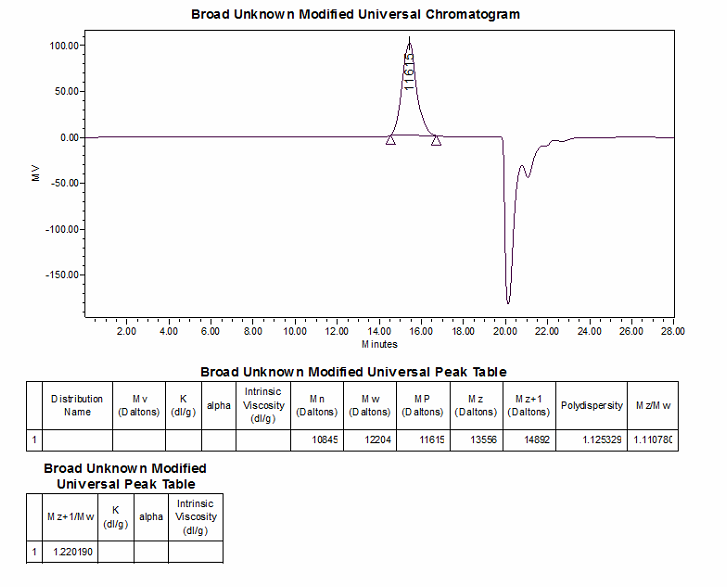
relative molecular weight
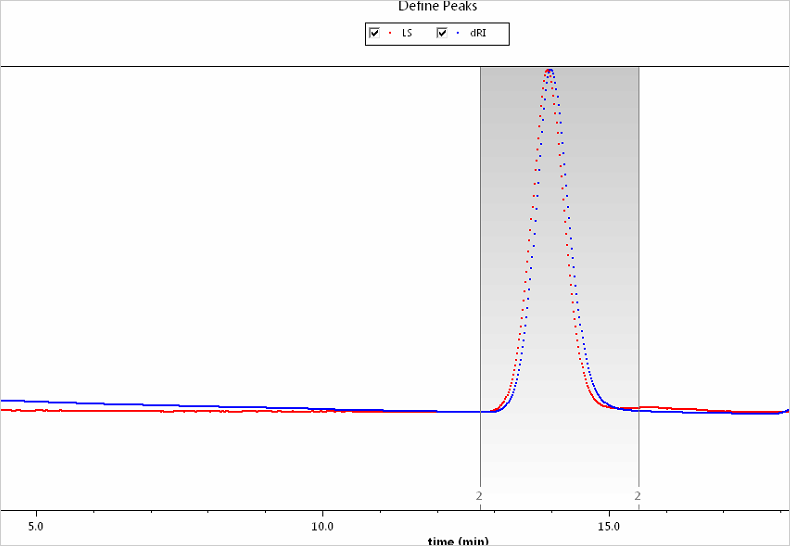
absolute molecular weight
FAQs

1. Why is the sample required to be solubility in the specified mobile phase?
Because GPC (gel permeation chromatography) is essentially a chromatographic test, it is necessary to separate the components of different molecular weights through the column, if the solubility is not good, it needs to be tested after filtering, and the molecular weight of the insoluble components cannot be tested, and if the solubility of the sample is poor, the sample may precipitate in the column and destroy the column.
2. Why is the test result different from the expected molecular weight?
First, the test principle of gpc is that each mobile phase has a corresponding standard curve made of a reference material, the sample test results should be compared with the standard curve, and then the test results are obtained. So most of the mobile phase results are the relative molecular weight of the sample, if the sample and the standard are too different, the test results may be much different from the true value. 2nd, GPC general test samples are polymers, and the expected molecular weight is only an expected value based on experimental design, which may be different from the actual situation.
3. What is the difference between relative molecular weight and absolute molecular weight?
First, the test principle is different: for relative molecular weight, molecular weight distribution is obtained through cpmparison of the sample curve with the standard curve of the reference material. While absolute molecular weight is calculated by the triple detector, the main principle is based on mathematical model of different laser scatterring angle on particle surface. second, the detector is different: the relative molecular weight is mainly a refractive indication detector, the absolute molecular weight needs difference-concentration-laser triple detector; third, The detection range of molecular weight is different: the relative molecular weight can detect smaller molecular weight, while the general molecular weight is more than tens of thousands to be suitable for absolute molecular weight.

Resources


Warning: Invalid argument supplied for foreach() in /wangzhan/www/anr.yo-l.com/wp-content/themes/anr/single.php on line 95